
The tools you already pay for can save you hours a week. You just need to know how to leverage them.
25+
Years of experience in entrepreneurship, business management, sales and marketing
500+
Hours of professional training given since 2014
600+
People trained in collaboration and management skills
50+
Client organizations from publicly traded companies and government agencies to startups, and nonprofits
Training: Generative AI in Your Tools — Get More From What You Already Have
Understand what your team is already paying for, close the gap with standalone tools, and stop leaving productivity on the table.
Summary
This interactive workshop helps participants get more out of the generative AI already built into the tools they use every day, such as Copilot for Microsoft 365 or Gemini for Google Workspace, and understand when a standalone tool like ChatGPT or Claude is the better choice. Most teams pay for these integrated tools and barely scratch the surface, missing out on tangible, everyday wins like building a graph or a complex pivot table directly in Excel, generating a first draft of a presentation from a template in PowerPoint, or drafting and correcting content right inside Word or Google Docs. Used well, these tools can save employees 3 to 8 hours a week on tasks they currently do manually or recreate from scratch across disconnected tools. Participants will leave knowing exactly which tool to reach for, when, and why, so the right tool gets used for the right task instead of guesswork that wastes time or produces inconsistent results.
Training plan
- What’s already built into your office suite, including Copilot for Microsoft 365 and Gemini for Google Workspace, and why most people barely scratch the surface
- What each integrated tool is genuinely best at, including building graphs and pivot tables in Excel, generating presentations from templates in PowerPoint, and drafting or correcting content in Word or Google Docs
- The productivity case: where the 3 to 8 hours a week are typically recovered, and why using the wrong tool often costs more time than it saves
- Where the suite tools hit their limits
- When a standalone tool like ChatGPT or Claude fills the gap, and why
- A side-by-side comparison: integrated versus standalone tools for common tasks
- Three common use cases: suite only, standalone only, and both used in combination
- The most common pitfalls: over-reliance on a single tool, inconsistent outputs, using the wrong tool for the task
- Compliance and data considerations: what should never go into any AI tool, privacy obligations, and where company data boundaries sit
Benefits & measurable improvements
Participants will walk away with:
- Between 3 and 8 hours a week back, by using the right tool, integrated or standalone, for the right task
- A clear framework for choosing the right tool for the right task, reducing wasted time on trial and error
- Practical fluency with the AI features already included in their existing software licenses, including document-native capabilities like Excel pivot tables and graphs, PowerPoint deck creation, and Word or Google Docs drafting
- An understanding of when standalone tools add real value, and when they simply add complexity
- Greater consistency across the team, reducing the risk of mismatched or unreliable outputs
- Reduced risk of compliance missteps through clear, actionable data guidelines
- A shared vocabulary that makes future tool decisions faster and less dependent on individual habits
Who it’s for
This training is ideal for:
- Businesses already paying for Microsoft 365 or Google Workspace who want to use the AI features included
- Teams juggling multiple AI tools without a clear sense of when to use which
- Leaders who want to avoid unnecessary software spend by maximizing what’s already licensed
- Employees who default to one familiar tool regardless of the task
Format
- Duration: 2 hours
- Delivery: In-person or virtual
- Approach: Interactive training combining practical exercises, real-world examples, and actionable takeaways
- Language: English or French
Discover our other training programs

Effective Communication & Expectations Management
Master communication, manage expectations to build trust, reduce misunderstandings, and improve collaboration in any work environment.

How to Give and Receive Feedback Effectively
Master the art of giving and receiving feedback. Build trust, foster growth, and create accountability with practical tools and proven conversation frameworks.

Maximize Productivity & Wellbeing at Work
Boost productivity and wellbeing with practical tools to manage workload, prioritize tasks, reduce stress, delegate effectively, and build sustainable habits.

How to Deal with Difficult Customers
Learn an established 8-step method to defuse tension, rebuild trust, and turn difficult client interactions into positive, solution-focused outcomes.

Give Effective Presentations to Create Impactful Outcomes
Deliver clear, confident, and engaging presentations. Master structure, credibility, and audience impact to be heard, and inspire action.

Effective Leadership & Management Performance
Develop the skills and mindset needed to lead effectively, build trust, and drive sustained, engaged performance.

AI Foundations: Build the Right Reflexes
Understand what generative AI actually is, build the habits that make it safe and useful, and walk away with concrete use cases for your team.

Team Commitment to Service Excellence
Turn individual accountability into a shared standard of service excellence that clients and colleagues can count on.

Navigating and Thriving Through Organizational Change
Navigate change with clarity and composure. Build resilience, sharpen adaptive leadership, and turn uncertainty into influence.
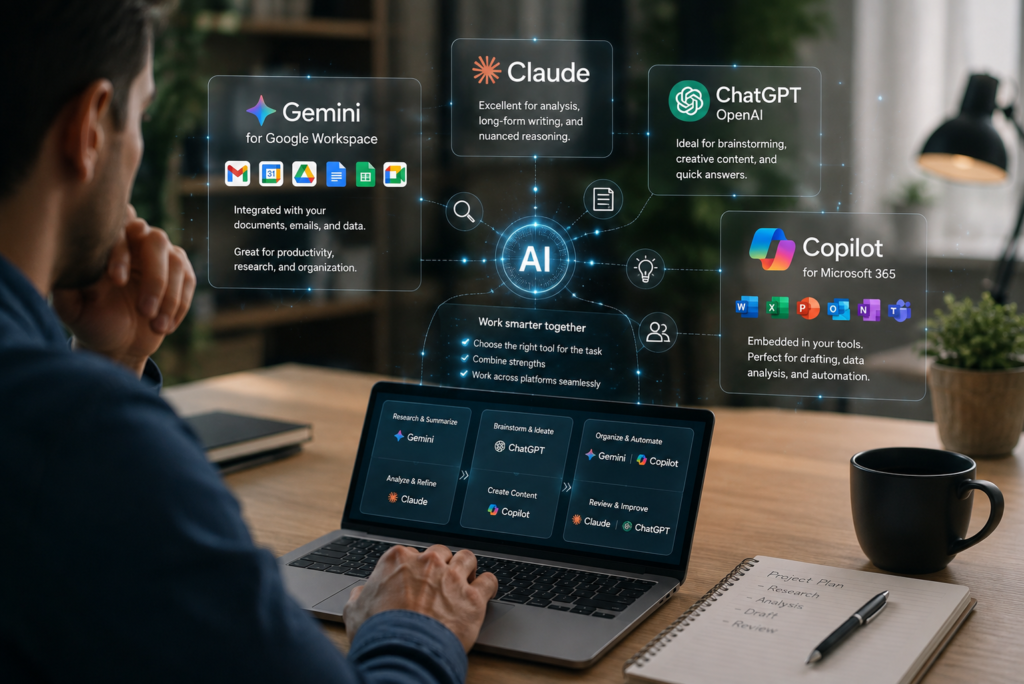
Generative AI in Your Tools: Get More From What You Already Have
Understand what your team is already paying for, close the gap with standalone tools, and stop leaving productivity on the table.

Demystifying AI Agents and First Steps Toward Automation
Tell prompting apart from automation, identify the two or three workflows worth automating first, and put the standards and oversight in place to do it safely.
Request a free discovery call to find out how I can support your growth.
Insights and best practices
Getting everyone rowing in the same direction: The overlooked job of leadership
It sounds almost too simple. Yet in business coaching and executive coaching, I keep seeing variations of the same problem: capable people working hard, but not necessarily working in the same direction. It may show up as slow decisions, duplicated effort, internal friction, missed handoffs, competing priorities or departments protecting their own interests. The symptoms…
Read more →
The management discipline behind effective AI
Artificial intelligence is changing how work gets done. But the management challenge underneath it is not new. Long before AI, leaders had to decide why a role existed, what it was responsible for, what outcomes it was expected to produce, where its authority started and stopped and how it interacted with other roles. They also…
Read more →
From Boss to Coach to Change Agent: The Evolution of the Modern Manager
For generations, being a manager largely meant knowing what needed to be done and making sure other people did it. That model is changing. Today, managers are expected to empower rather than control, coach rather than simply direct, develop people rather than just evaluate them and help their teams navigate constant change. Add hybrid work,…
Read more →
Strategic Thinking: The Leadership Skill Behind Better Decisions and Stronger Strategy
Strategic thinking is often associated with strategic planning. But they are not the same thing. A strategic plan defines where an organization intends to go and how it plans to get there. Strategic thinking happens before, during and beyond that process. It is the discipline of questioning assumptions, exploring possibilities and understanding implications before deciding…
Read more →
Why Understanding People Is the Foundation of Influence at Work
Dale Carnegie's How to Win Friends and Influence People has remained influential for nearly a century because it recognized something fundamental: if you want to influence someone, start by understanding what matters to them.
Read more →
Knowing your numbers is a leadership accelerator
One of the clearest differences between professionals who remain operational and those who become influential leaders is their understanding of the numbers that drive the business. Not just financial metrics. The numbers that explain performance, priorities, constraints, risks, efficiency, customer impact, delivery capacity, growth, quality, or strategic progress. At every level of an organization, people…
Read more →