Why Understanding People Is the Foundation of Influence at Work
Reading time: 5 min.
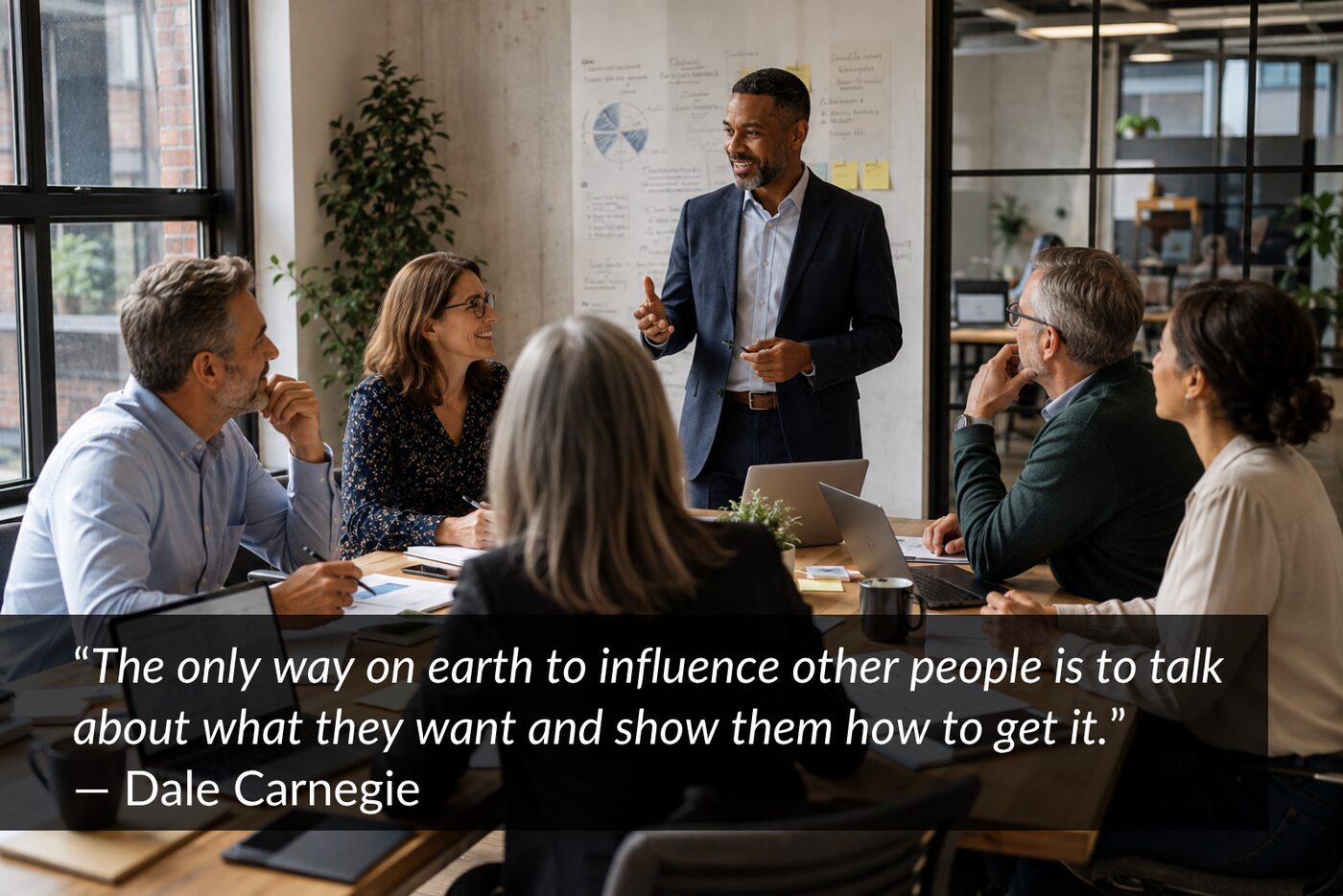
Dale Carnegie’s How to Win Friends and Influence People has remained influential for nearly a century because it recognized something fundamental about human behaviour: if you want to influence someone, start by understanding what matters to them.
One of Carnegie’s central principles was to become genuinely interested in other people, understand their point of view and speak in terms of their interests. In today’s business world, that principle applies far beyond building relationships. It is fundamental to selling, leading, negotiating, managing change and gaining support for ideas.
Whether the person in front of you is a customer, an employee, a colleague, a partner or a senior executive, your ability to influence an outcome depends in part on how well you understand their reality.
Your perspective is not their reality
Every stakeholder sees an organization through a different lens.
A CEO may be focused on growth, risk and profitability. A department head may be concerned about resources and execution. An employee may worry about workload or job security. A customer may be evaluating whether a supplier can deliver without creating new problems.
They may all be discussing the same initiative while having completely different concerns about it. This is why technically sound ideas can still encounter resistance.
The problem is not always the quality of the solution. Sometimes we have simply failed to understand what the other person needs to achieve, protect or feel confident about before they can support it.
Understanding someone means going beyond their stated position. It means asking:
- What are they trying to accomplish?
- What pressures are they facing?
- What keeps them up at night?
- What are they afraid of losing?
- What constraints are they working within?
- How will they define success?
- Who or what influences their decisions?
Human decisions are rarely driven by logic alone. Context, incentives, relationships, experience and perceived risk all shape how people respond.
The customer is more than the person buying from you
This principle is particularly visible in sales.
A traditional approach focuses on understanding customer needs so that we can present the right solution. A deeper approach asks what is happening around those needs.
What problem is the customer actually trying to solve? Why does it matter now? What happens if nothing changes? What are they worried might go wrong? What criteria will they use to compare alternatives? Who else will influence the decision?
A useful buyer journey should therefore capture more than the steps leading to a purchase. It should help us understand the psychological and organizational factors behind the decision.
What keeps the customer awake at night? What would make them confident enough to move forward? What risks do they need to be reassured about?
Understanding these dimensions changes the conversation. Instead of simply explaining why our offering is valuable, we can address the specific concerns and outcomes that matter to the person making the decision.
The same principle applies inside the organization
The customer is not always external.
Managers need to influence people they do not directly control. Project leaders need cooperation from other departments. Executives need support for strategic decisions. Consultants need clients to adopt recommendations. Leaders introducing change need people to move from agreement to action.
In each case, understanding the organizational context is essential. Who owns the issue? Which department benefits? Which department carries the additional workload? What competing priorities exist? Where have similar initiatives failed before? What informal relationships influence decisions? What political or operational realities might not appear on the organizational chart?
A recommendation can be perfectly logical and still fail because it conflicts with the reality of the organization. Effective influence therefore requires both individual understanding and organizational understanding.
Understand the person behind the role
There is another layer that is easy to overlook.
Two people with the same position, responsibilities and objectives can respond very differently to the same situation.
Personality and behavioural tools such as InSelf or other validated profiling approaches can provide useful perspectives on communication preferences, decision-making tendencies, motivations and potential sources of stress.
The purpose is not to put people into boxes. It is to recognize that the way we naturally communicate may not be the way another person receives information.
A highly analytical decision-maker may need evidence and time to evaluate an idea. Someone more relationship-oriented may first need confidence in the people involved. Someone focused on results may want to understand the expected outcome before discussing the details.
The message may be the same. The way we communicate it may need to change.
Map the stakeholders before trying to influence them
When an important decision involves several people, individual understanding is not enough. We also need to understand the stakeholder landscape.
A simple stakeholder map can reveal who is likely to support, resist or remain neutral toward an initiative.
The important question is not simply who is a supporter or detractor? It is why?
A stakeholder may resist because they disagree with the strategy. Another may resist because they expect additional workload. Someone else may support the initiative but lack the influence to move it forward. Those differences matter. Once we understand them, we can develop a more deliberate approach.
A supporter might need to be mobilized. A neutral stakeholder might need more information or reassurance. A detractor might need legitimate concerns addressed or a different form of engagement.
The goal is not manipulation. It is understanding before engagement.
Influence starts before the conversation
One of the most useful shifts in thinking is to move the work of influence earlier.
Before an important meeting, presentation, negotiation or decision, ask yourself:
What do I know about the people I need to influence?
Not just their titles. Their objectives, pressures, concerns, incentives, relationships, decision criteria and previous experiences.
Then ask:
What am I assuming that I don’t actually know?
That question can be surprisingly revealing.
We often mistake familiarity for understanding. We have worked with someone for years and assume we know what they think. We know a customer’s industry and assume we understand their business. We understand someone’s role and assume we understand their priorities.
Knowing someone’s position is not the same as knowing their perspective.
The influence advantage
The strongest influencers are not necessarily the most persuasive people in the room. They are often the people who have done the most work to understand the room.
They know what matters to different stakeholders. They anticipate concerns. They adapt their message without compromising the objective. They recognize where resistance comes from and distinguish genuine disagreement from fear, uncertainty or competing interests.
This does not mean manipulating people. Good influence starts with respecting the fact that other people have their own objectives, constraints and realities. When we understand those realities, we can find better ways to create alignment.
That is the real value of knowing your stakeholders deeply. It helps you serve customers better, lead more effectively, navigate organizational complexity and make better decisions about how to engage people.
Before trying to influence someone, ask yourself one simple question:
Do I understand their world as well as I understand my own?
If the answer is no, the next step may not be to build a better argument. It may be to ask better questions.