Strategic Thinking: The Leadership Skill Behind Better Decisions and Stronger Strategy
Reading time: 6 min.
Strategic thinking is often associated with strategic planning. But they are not the same thing.
A strategic plan defines where an organization intends to go and how it plans to get there. Strategic thinking happens before, during and beyond that process. It is the discipline of questioning assumptions, exploring possibilities and understanding implications before deciding what to do.
For leaders and business owners, it is an essential skill because the quality of strategic decisions depends largely on the quality of thinking behind them.
What strategic thinking actually means
Strategic thinking is not simply thinking long term or looking at the “big picture.” It is not the same as being creative, generating ideas or solving complex problems.
At its core, strategic thinking means deliberately stepping outside the assumptions that shape our current view of the business and asking whether there are other ways to understand the situation, pursue our objectives or respond to what is changing around us.
We rarely approach a strategic decision with a blank slate.
Our experience tells us what customers want. Our history tells us what has worked. Our financial results tell us what seems realistic. Our existing capabilities influence what we believe we can do.
These are useful reference points. They can also become constraints on our thinking.
Research on managerial cognition and organizational learning shows how mental models and underlying assumptions influence strategic decisions. Chris Argyris’s work on double-loop learning adds an important distinction: organizations can improve their actions without ever questioning the assumptions that produced those actions.
Strategic thinking creates the space to do exactly that.
What are we assuming to be true, and what if some of those assumptions are no longer valid?
Start with the North Star
Strategic thinking should not mean generating endless possibilities without direction.
It needs an anchor.
An organization’s purpose, mission and vision establish what it exists to accomplish and what it ultimately wants to become. They provide the context for strategic choices.
But even these deserve periodic examination.
Do we still agree on what our vision means? Is it ambitious enough? Does it reflect where we want to go or simply describe where we have been heading?
Once the direction is clear, strategic thinking opens up the question of how to get there.
Imagine a company whose ambition is to become the leading provider in its market so it can serve more customers.
There may be several ways to pursue that ambition:
- Expand geographically
- Deepen the range of services offered
- Enter adjacent customer segments
- Develop new revenue streams
- Change the delivery model
- Acquire complementary businesses
The point is not to generate as many options as possible. It is to avoid assuming that the most familiar path is the only path.
The vision provides the direction. Strategic thinking expands the field of choices.
Challenge the assumptions behind your strategy
Every strategy contains assumptions, whether explicitly stated or not.
We assume certain customers will continue to buy. We assume particular markets will grow. We assume our competitive advantages will remain relevant. We assume our people, systems and financial resources will support our ambitions.
Some of these assumptions will prove wrong.
The problem is not having assumptions. The problem is failing to recognize them as assumptions.
A useful discipline is to ask:
What would have to be true for our strategy to work?
Then:
Which of those conditions are within our control, and which are not?
And perhaps most importantly:
Which assumption, if it proved wrong, would force us to rethink our strategy?
This is where strategic thinking differs from simply reviewing performance.
A performance review may tell you that sales are below target. Strategic thinking asks whether the problem is execution, the assumptions behind the sales strategy or something that has fundamentally changed in the market.
If the problem is execution, improve execution.
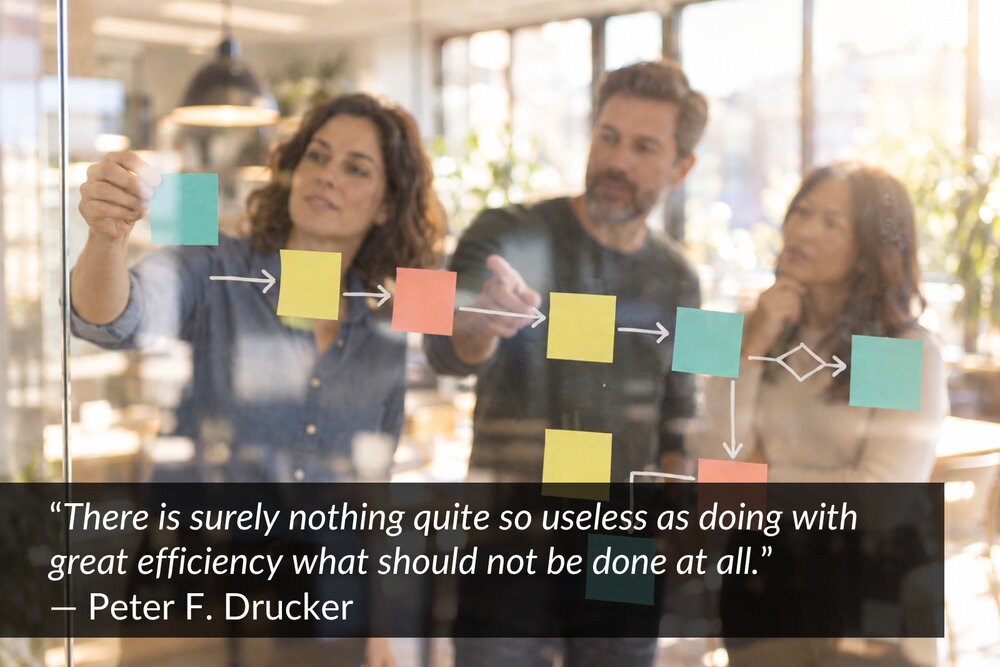
If the underlying assumption is wrong, improving execution may simply make you more efficient at pursuing the wrong strategy.
Deliberately change the frame
One of the most powerful ways to think strategically is to change the frame through which you are looking at a situation.
Imagine a company generating $10 million in annual revenue.
The conventional question might be:
How do we grow by another 10 percent?
A very different question is:
What would we have to change to become a $20 million company within three years?
The objective isn’t necessarily to double revenue. The question is useful because it changes the mental model.
Suddenly, possibilities that might never have entered the original discussion become relevant. Perhaps the company needs new markets, new services, a different delivery model or an acquisition.
It also exposes implications.
What would happen to cash requirements? What capabilities would be needed? Could the current leadership team manage the complexity? Would the organization need to change?
And eventually, a more fundamental question might emerge:
Do we actually want to become the company required to achieve that level of growth?
That is strategic thinking at work.
Research on strategic foresight and scenario planning supports this principle. Exploring alternative futures isn’t primarily about predicting what will happen. It helps challenge existing mental models, identify possibilities and test the robustness of current choices.
Follow the implications
Strategic thinking should not stop when someone comes up with an interesting idea.
This is where it differs from brainstorming.
The critical question is:
If we chose this path, what else would have to change?
A strategic decision rarely affects only one part of an organization.
Doubling revenue could affect:
- Capacity
- Hiring
- Leadership structure
- Technology
- Working capital
- Processes
- Customer experience
- Organizational culture
This interconnectedness is why systems thinking matters. Changes in one part of an organization often create consequences elsewhere.
If we enter a new market, what does that require?
If we acquire a company, what does integration require?
If we significantly expand our service offering, what happens to complexity?
If we reduce prices to gain market share, what happens to our economics and positioning?
The question isn’t simply “Could we do this?”
It is:
What would doing this require, and what else would it change?
Strategic thinking applies beyond strategy
You don’t need to be working on the organization’s strategic plan to think strategically.
Consider a performance problem.
An operational approach asks:
How do we get this employee to perform better?
A strategic approach might ask:
What is this situation telling us about the role, our expectations, our management practices or the way the organization is designed?
Or consider a recurring capacity problem.
The immediate response might be to hire more people.
Strategic thinking asks:
Why does this problem keep occurring, and what would need to change so that additional people are no longer the default solution?
Or consider declining sales.
The immediate response might be to increase sales activity.
Strategic thinking asks:
Has something changed in our customers, our market or our value proposition that makes our previous approach less effective?
Strategic thinking changes the questions we ask before we act.
A simple test for strategic thinking
When facing an important decision, pause before jumping to the answer.
Ask:
What are we trying to accomplish?
Reconnect the decision to the organization’s purpose, vision or strategic priorities.
What are we assuming?
Make the beliefs behind the current thinking visible.
What alternatives are we not considering?
Deliberately expand the field of possibilities.
What if the situation were materially different?
Use plausible scenarios to challenge the current frame.
If we chose this path, what else would change?
Explore the second-order consequences.
What would cause us to reconsider?
Identify the conditions that would make the decision no longer appropriate.
You don’t need to ask all six questions every time. The discipline is recognizing when a decision deserves more than an immediate operational response.
The quality of the thinking determines the quality of the strategy
Strategic thinking doesn’t guarantee that you will make the right decision. The future remains uncertain, information will always be incomplete and assumptions will sometimes prove wrong.
Its value is different.
It helps leaders avoid making consequential decisions simply because they are the logical extension of what they already believe.
It creates room to see alternatives. It exposes assumptions. It reveals implications. And it helps organizations make choices that are more deliberate and aligned with where they actually want to go.
That is why strategic thinking matters before a strategic plan is written, while it is being executed and whenever circumstances require the organization to reconsider its direction.
A strategic plan can tell you what you intend to do.
Strategic thinking helps you determine whether it is still the right thing to do.
And perhaps the simplest question to carry into your next important decision is:
Are we thinking about this decision strategically?