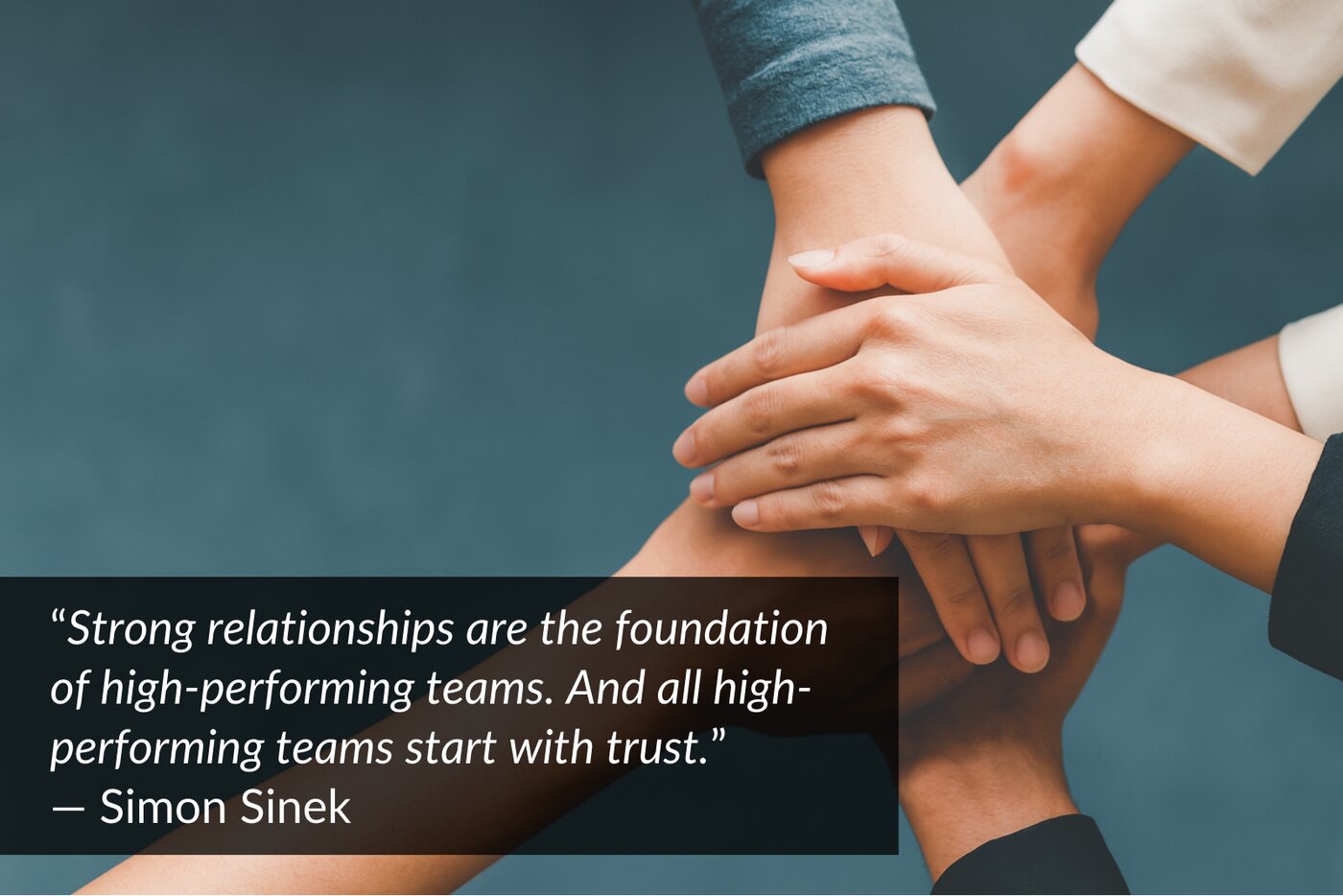
Why trust is the hidden engine of high-performing teams
Reading time: 4 min.
Trust is the quiet force that makes collaboration possible. It shapes how teams communicate, solve problems, take risks, and show up for one another. When trust is high, work flows. When trust is weak, friction becomes the default operating system.
Yet trust is often assumed rather than cultivated. It is treated as something teams “have” instead of something people build, maintain, and renew through consistent behaviour.
This post explores why trust sits at the foundation of every effective team, how it influences organizational performance, and what leaders can do to measure and strengthen it.
Why trust is the foundation of teamwork
Patrick Lencioni’s work on team dysfunctions places trust at the base of his pyramid for a simple reason: without it, nothing else works. You cannot have healthy conflict, real accountability, or sustained commitment without a foundation of psychological safety and reliability.
Trust is not about liking each other. It is not about avoiding conflict. Trust is the result of a pattern built over time:
• Clear expectations
• Predictable behaviour
• Consistency between words and actions
• Shared norms that are honoured over time
It earns its power from repetition. Every interaction reinforces or erodes it.
How humans actually evaluate trust
Whether consciously or unconsciously, we are always evaluating how much we can trust others. Neuroscience research shows that we track cues of reliability, fairness, competence, and benevolence almost automatically. Each interaction, no matter how small, becomes a data point.
This explains why trust is easy to damage and slow to rebuild. When trust is broken through unreliable, dismissive, or self-interested behaviour, the brain doesn’t forget. It adjusts its expectations and its level of openness.
Teams perform at the level of trust they collectively experience, not the level leaders believe exists.
How trust shows up in everyday work
Trust is not abstract. It shows up through simple, observable behaviours:
• Providing reliable and truthful information
• Acting with sincerity and noble intent
• Being mindful of context, constraints, and stressors
• Demonstrating competence consistently
• Following through on commitments, large or small
These behaviours build “predictive trust” (I know what to expect from you) and “vulnerability-based trust” (I can be open with you without fear). Teams need both.
The benefits of high trust in teams
When trust is strong, everything moves differently:
• Faster decision-making because people don’t over-verify or second-guess
• Better collaboration and information sharing
• More constructive conflict and better problem-solving
• Higher psychological safety, which fuels creativity and innovation
• More generous interpretations of colleagues’ intentions
• Stronger resilience when pressure increases
High trust doesn’t eliminate problems. It allows teams to solve them faster and with less collateral damage.
The costs of low trust
Low trust behaves like organizational friction: it slows everything down and wears people out. Its symptoms are obvious once you know what to look for:
• Misunderstandings that escalate into avoidable conflict
• Silence in meetings because speaking up feels risky
• Chronic defensiveness or politicking
• Workarounds or parallel processes because people don’t rely on each other
• Leaders who avoid difficult conversations until issues become crises
• Emotional tax: frustration, burnout, disengagement
Low trust is rarely about one big betrayal. It’s usually the accumulation of small inconsistencies.
What trust looks like at the organizational level
The impact of trust goes far beyond individual teams.
High-trust organizations:
• Execute faster with fewer layers of control
• Build stronger cross-functional collaboration
• Attract and retain talent because the environment feels fair and predictable
• Spend more energy on customers and strategy rather than internal negotiation
• Enable leaders to lead instead of managing around fear or uncertainty
Low-trust organizations:
• Rely on bureaucracy because confidence is low
• See breakdowns in strategy execution due to siloed information
• Experience higher turnover and lower engagement
• Get trapped in escalation cycles because people don’t feel safe to address issues early
• Spend attention on internal politics rather than meaningful work
Trust is not a cultural “nice to have.” It is a performance system.
How to gauge or measure trust
Trust can be measured more easily than leaders think. Indicators include:
• Psychological safety levels (employees’ willingness to speak up)
• Meeting behaviours (candor, participation, quality of debate)
• The ratio of commitments made vs. commitments kept
• Cross-functional cooperation and handoff quality
• Pulse surveys on reliability, fairness, transparency, and respect
Even structured conversations can reveal trust gaps with surprising clarity.
Behaviours that strengthen trust
Trust grows from what teams do consistently, not what they intend. Key behaviours include:
• Following through, especially on small commitments
• Explaining intent before taking action
• Addressing misunderstandings early
• Being direct and respectful in conversations
• Owning mistakes without defensiveness
• Seeking others’ perspectives before judging
• Giving timely feedback rooted in shared goals
• Modelling vulnerability at the right level
These behaviours create an upward spiral: more openness leads to more collaboration, which builds more trust.
Trust is not soft. It is structural.
It shapes speed, alignment, engagement, innovation, and execution.
It is built slowly, lost quickly, and regained only through consistent behaviour.
Leaders who treat trust as an asset rather than an assumption create environments where people collaborate, challenge each other constructively, and achieve outcomes that would be impossible otherwise.
Trust is the quiet force behind exceptional teams. When you understand how it works and choose to cultivate it deliberately, everything else becomes easier.