Three simple, science-grounded reflection questions to close the year with clarity
Reading time: 4 min.
As the year comes to a close, many of us feel the urge to slow down and take stock. And yet, we rarely do it well.
We either skip reflection altogether or turn it into a vague mental recap that quickly dissolves into plans for what’s next. What often gets lost in the process is something essential: a clear sense of how much we’ve actually grown.
This is a simple year-end reflection practice I’ve used for years. I do it personally every single year, and I also revisit it with the managers and leaders I coach during our last coaching session of the year. It’s a memorable and meaningful way to wrap up the year at their side. I often have the privilege of pointing out accomplishments they may have forgotten or taken for granted, and of reminding them how important it is to allow themselves to feel proud of what they’ve achieved.
It’s not a performance review, not a goal-setting exercise, and not something reserved for executives. It’s a human practice, for anyone who wants to close the year with perspective, meaning, and intention.
The practice revolves around three questions. Each one plays a distinct role in helping you recognise progress, extract meaning from the year, and move forward with agency.
Q1: What are 1 to 3 successes you are particularly proud of this year?
The ritual
Choose one to three concrete successes from the year, ideally ones where your involvement truly mattered. These can be professional or personal.
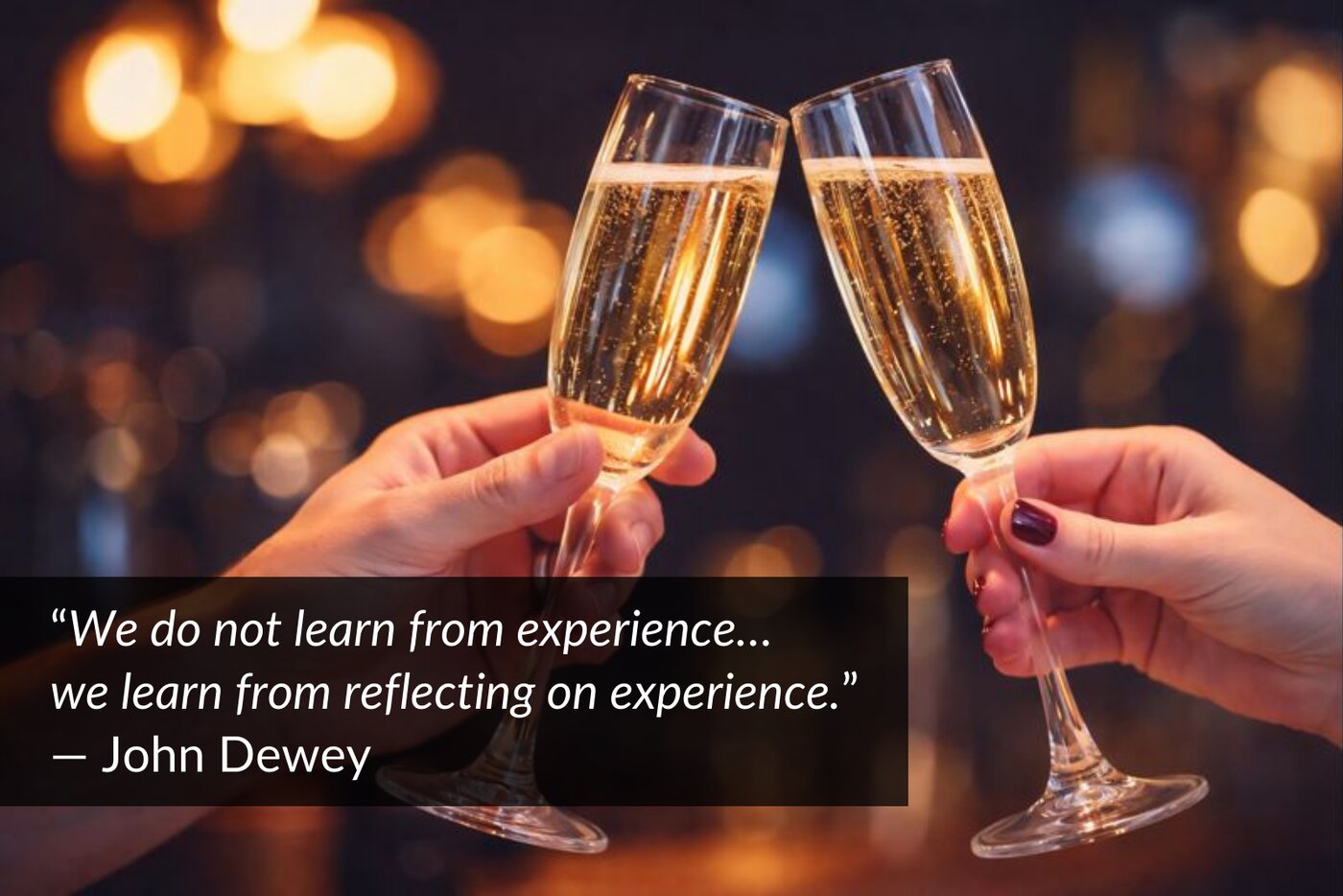
Then pause. Take a breath, raise a glass, and think to yourself:
“I’m proud of what I’ve accomplished this year.”
Let the moment land before moving on.
Why this matters
Most thoughtful, driven people rarely stop to recognise their own achievements. We move quickly from one challenge to the next, discounting success as “normal,” “expected,” or “not enough.” Promotions, milestones, difficult conversations handled well, progress made quietly over time. All of it gets erased by momentum.
Without intentional acknowledgement, growth becomes invisible. And when growth is invisible, confidence and motivation quietly erode.
This step is not about ego or complacency. It’s about accuracy. About telling yourself the truth of what you actually delivered this year.
The science behind the practice
Research on strengths-based reflection and appreciative practices shows that acknowledging concrete successes improves confidence, motivation, and sustained performance. Pausing to recognise achievement also helps encode learning and progress more durably in memory. If you don’t mark it, your brain is likely to move on as if it never happened.
Q2: What are 1 to 3 learnings or realisations you had this year?
The ritual
Think back on moments where something clicked. A situation you understand better now. A dynamic you see more clearly. A pattern you finally recognised.
Focus less on tools or techniques and more on shifts in understanding. Name what you see today that you didn’t see a year ago.
Why this matters
Learning often happens quietly. It doesn’t always announce itself as a breakthrough. As a result, we tend to take it for granted. High achievers, in particular, normalise learning very quickly. What once required effort now feels obvious, and because it feels obvious, it gets dismissed.
When learning isn’t named, it fades. When it is named, it becomes part of how you see yourself and your capacity to adapt. This step reinforces a powerful truth: you didn’t just get through the year, you grew through it.
The science behind the practice
Adult learning research shows that insight sticks when it is explicitly articulated. Reflecting on shifts in mental models, not just skills, accelerates adaptive learning and better judgment over time. Naming what you’ve learned helps you retain it and build on it.
Q3: What are 1 to 3 things you would like to do differently next year?
The ritual
Choose a small number of intentional shifts you want to experiment with next year. Anchor them directly in what you learned this year.
Avoid grand resolutions. Treat these as experiments, not promises to become a different person overnight.
Why this matters
Many year-end intentions are disconnected from lived experience. They are based on ideals, pressure, or comparison rather than wisdom. On top of that, we often choose too many goals, which dilutes focus and follow-through.
This question restores a sense of agency. It asks: given what you now know, how will you move differently? It frames the new year not as a reset, but as a continuation.
The science behind the practice
Forward-looking reflection improves goal quality and follow-through. Research consistently shows that small, experience-based adjustments outperform sweeping change. Progress compounds when it builds on what you already understand.
Making this a yearly ritual
This practice becomes especially powerful when repeated year after year.
Capture your answers in a simple year-end note or journal. Revisit past years from time to time. Patterns emerge. Progress becomes visible. Difficult periods gain context.
You can do this reflection alone or share it with someone you trust. In either case, it creates continuity, perspective, and a moment you can actually look forward to.
You can also apply it to different areas of your life, professional, personal, or both. The questions hold.
Year-end journaling prompts
1. What are 1 to 3 successes this year that you are particularly proud of?
2. What are 1 to 3 learnings or realisations you had this year?
3. What are 1 to 3 things you would like to do differently next year?
Wrapping up the year with wisdom
Year-end reflection doesn’t need to be heavy or complicated to be meaningful. This simple practice works because it respects how growth actually happens: through experience, reflection, and small intentional shifts over time.
If you do one thing before the year closes, make it this. Pause long enough to see how far you’ve come, what you’ve learned along the way, and how you want to carry that wisdom forward. Over time, these moments of clarity accumulate into something powerful: confidence rooted in reality, perspective earned through experience, and a deeper appreciation of your own path.