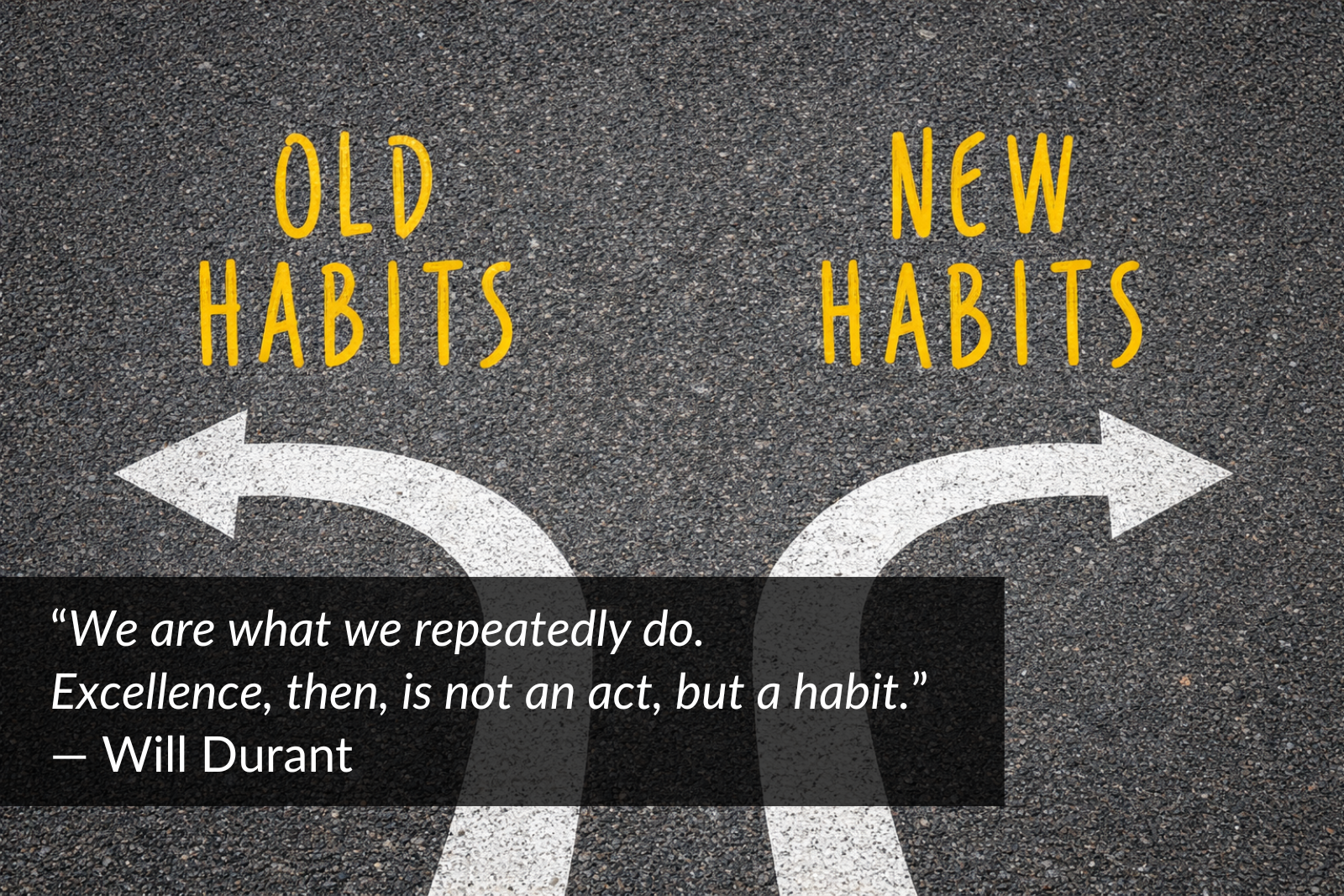
Every January, we talk about goals.
What we rarely talk about is the skill that actually determines whether those goals will ever materialize.
That skill is forming habits.
Not productivity hacks.
Not motivation.
Not willpower.
Habits.
At work and in life, the most sudden and durable progress rarely comes from doing more. It comes from adjusting what you already do automatically or installing one new behavior that quietly runs in the background.
This is why habits matter so much. Once formed, they require almost no conscious effort. And that is precisely what makes them powerful.
Why habits work: a brief look at the science
Your brain operates using two complementary modes of thinking, a distinction popularized by Daniel Kahneman in his work on decision-making and cognition.
He described these as fast, automatic thinking and slow, deliberate thinking, often referred to as System 1 and System 2. Fast, automatic thinking is where we spend the vast majority of our day, roughly 90% of our mental activity. Slow, deliberate thinking accounts for the remaining 10%, when we switch to mindful problem-solving, learning, or conscious decision-making.
Habits live almost entirely in the first mode.
They are efficient because they bypass decision-making.
But there is a paradox.
To build a habit, you must initially rely on slow, deliberate thinking. You have to decide, design, and repeat the behavior intentionally before it becomes automatic.
This is why forming habits feels hard at first and effortless later. You are literally transferring the behavior from conscious control to automatic execution.
How long does it take to form a habit?
There is no single magic number.
Research suggests that habit formation typically takes several weeks to a few months, depending on the behavior, the context, and the individual.
A frequently cited longitudinal study by Phillippa Lally and colleagues at University College London found that habit automaticity took between 18 and 254 days, with an average of 66 days. The wide range matters. It shows that consistency matters far more than speed, and that simple habits stabilize faster than complex ones.
This has a critical implication.
Trying to form several habits at the same time dramatically increases cognitive load and reduces your odds of success.
One habit at a time beats ambition every time
Forming a habit requires conscious energy.
Forming multiple habits at once competes for that same limited resource.
A practical and evidence-aligned approach is:
• Focus on one habit at a time
• Give it enough time to stabilize before adding another
Working on one habit per month is realistic and sustainable for most people.
Over a year, that can mean 9 to 10 deeply ingrained habits that operate almost unconsciously and generate powerful compounded impact.
This is how real change happens. Quietly. Incrementally. Permanently.
Define the habit with surgical clarity
One of the most common mistakes people make is confusing goals with habits.
Goals are directional.
Habits are executable.
Compare these two statements:
• “I want to become stronger and lose weight this year.”
• “I will do push-ups every day.”
The first is vague and aspirational.
The second is concrete, measurable, and repeatable.
A good habit definition answers three questions:
• What exactly is the action?
• When will it happen?
• Where will it happen?
If the habit is fuzzy, it will fail.
Two habit-building tactics that actually work
Once the habit is clearly defined, repetition becomes the priority. Two techniques consistently increase success rates.
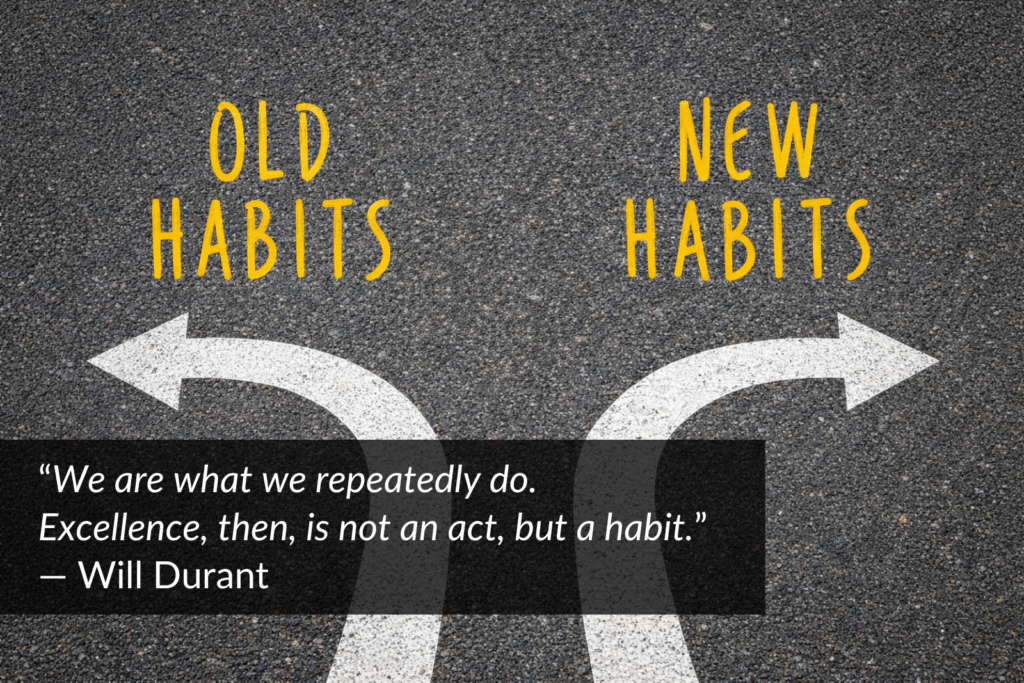
1. Attach the new habit to an existing one
This works because your brain already recognizes the existing routine as a cue.
Instead of asking yourself to remember a new behavior randomly, you piggyback it onto something you already do.
For example:
• Do push-ups right before your daily shower
• Stretch after brushing your teeth
• Review priorities after opening your laptop
The existing habit becomes the trigger. No extra thinking required.
2. Use reminders until the habit no longer needs them
Reminders are scaffolding, not a failure.
• Phone alarms
• Calendar nudges
• Post-its in visible locations
The key is to snooze or repeat reminders, not dismiss them, until the behavior feels automatic. Once the habit is established, the reminder becomes unnecessary.
Why adjusting habits is harder than creating new ones
Most habits are unconscious. That is their strength and their weakness.
It is often easier to create a new habit from scratch than to modify an existing one.
Editing an existing habit keeps you in constant negotiation with an automatic behavior. In contrast, adding or removing a habit reduces friction.
For example, trying to drink less coffee by switching between regular and decaf requires repeated decisions. Each choice reactivates conscious effort.
Introducing a new behavior, such as drinking herbal tea in the afternoon instead of coffee, avoids that friction entirely.
When possible, remove or add, rather than edit.
A personal example: building a mindfulness habit
One habit I want to develop this year is greater consistency in mindfulness practice.
Here is how I am defining it:
• Action: At least 10 minutes of mindfulness or meditation
• Frequency: Every day
• Anchor: Right after waking up or right before going to bed
I already use an app, which removes friction. No planning. No decision-making. Just sitting down and following the flow of the practice.
At this point, the only requirement is diligence.
Not motivation. Not inspiration. Repetition.
A note for managers: habits quietly shape leadership effectiveness
For managers, habits matter even more than intentions or leadership style.
Leadership is largely expressed through repeated micro-behaviors:
• How consistently expectations are clarified
• Whether feedback happens regularly or only when problems arise
• How decisions are followed up, or quietly fade away
One management habit worth strengthening this year is closing loops explicitly. After meetings or key conversations, this can be as simple as consistently asking:
• “What did we decide?”
• “Who owns what?”
• “By when?”
It is a small habit, but it dramatically reduces ambiguity, rework, and frustration across a team.
When thinking about your own team, two questions are particularly powerful:
• What habit should we start this year that would make execution smoother?
• What habit should we remove because it creates drag, confusion, or unnecessary pressure?
Culture is not shaped by values posters or one-off initiatives.
It is shaped by habits that no longer require reminders.
The quiet power of habits
Habits shape outcomes far more than goals ever will.
They influence how you start your day, how you manage pressure, how you show up for others, how you learn, and how you recover over time. In professional contexts, they quietly determine whether good intentions translate into consistent execution.
If you want this year to be different, don’t aim higher.
Design better habits.
Start with one.
Make it clear.
Attach it to what already exists.
Repeat until it runs on autopilot.
That is how progress becomes inevitable, at work and in life.