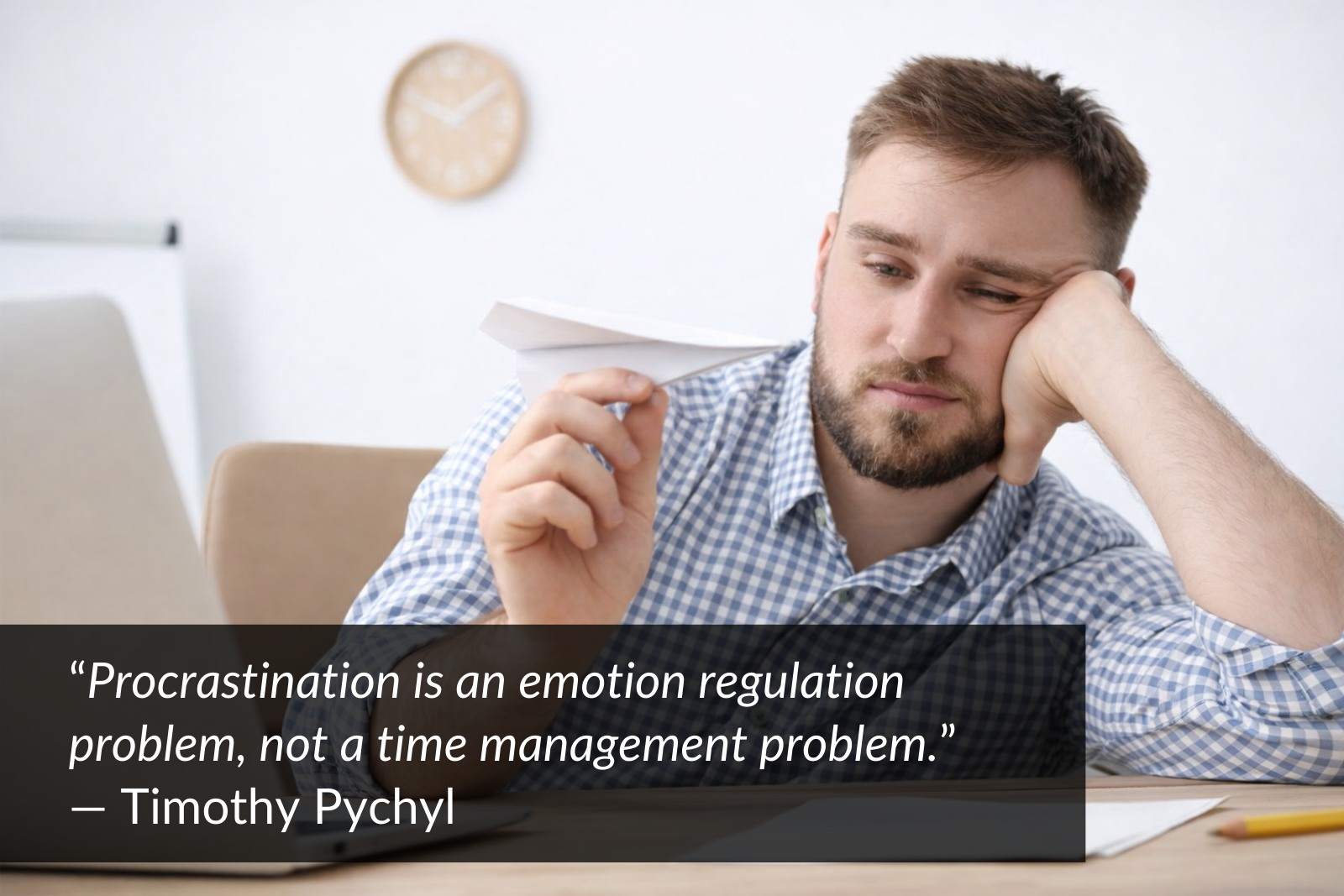
You don’t procrastinate because you are lazy.
You procrastinate because something about the task feels psychologically unsafe.
Notice what you tend to delay:
• Preparing your personal taxes
• Finalizing your yearly department budget
• Conducting a performance review with an underperforming employee
• Writing a long, high-stakes RFP
• Initiating a difficult strategic conversation
These tasks matter. They have consequences. They define credibility.
And they are frequently postponed.
The paradox is this: the more important the task, the more likely we are to delay it.
Procrastination is rarely a time management problem. It is an emotional regulation strategy.
Procrastination is mood repair, not laziness
Researcher Timothy Pychyl has spent decades studying procrastination. His conclusion is clear: procrastination is about managing emotions, not managing time.
Psychologist Joseph Ferrari describes procrastination as a self-defeating behavioral pattern driven by avoidance.
When we delay a task, we are choosing immediate emotional relief over anticipated discomfort.
In the moment, avoidance works.
• Anxiety drops
• Tension softens
• We feel temporarily better
Until the deadline approaches.
Procrastination is not a productivity flaw. It is a coping mechanism.
Why important tasks trigger more avoidance
Important tasks activate identity and visibility.
A budget exposes judgment.
A performance review exposes leadership courage.
An RFP exposes competence.
Taxes expose financial reality.
High-stakes tasks activate:
• Fear of failure
• Fear of judgment
• Fear of conflict
• Fear of exposure
• Fear of being wrong
The brain is wired to protect identity and social standing. When a task threatens either, the nervous system reacts.
The higher the psychological stakes, the stronger the impulse to delay.
This is why intelligent, high-performing leaders procrastinate on the very tasks that define their impact.
The five most common psychological drivers of procrastination
1. Fear of failure
Starting creates the possibility of falling short.
If I don’t start the RFP, it cannot be rejected.
If I postpone the performance review, I avoid confrontation.
If I delay the budget, I avoid exposing assumptions.
Avoidance protects ego in the short term.
2. Maladaptive perfectionism
Adaptive perfectionism drives standards.
Maladaptive perfectionism creates paralysis.
• The document must be excellent
• The numbers must be flawless
• The feedback must be perfectly worded
• The strategy must be airtight
When the internal bar is unrealistic, starting feels unsafe.
So we wait for clarity, confidence, or inspiration.
They rarely arrive.
3. Overwhelm and ambiguity
The brain avoids what it cannot structure.
Large tasks such as:
• Writing a complex RFP
• Designing a strategic plan
• Preparing a full-year budget
• Organizing tax documentation
Create cognitive load.
When the next step is unclear, friction rises.
Instead of starting the ambiguous task, we default to smaller, clearer ones.
It feels productive. It is still avoidance.
4. Lack of intrinsic meaning
Some tasks feel heavy because they feel disconnected from identity.
• Administrative work
• Compliance tasks
• Political conversations
When autonomy or meaning is low, activation drops.
Procrastination here often signals misalignment rather than laziness.
5. Identity transition
Growth requires new behaviors.
Delivering tough feedback requires emotional maturity.
Owning a department budget requires financial leadership.
Submitting an ambitious proposal requires confidence.
You are not just completing a task. You are stepping into a new level of responsibility.
That transition can feel threatening.
Avoidance delays identity evolution.
The neurological tension
Procrastination reflects a tension between emotional impulses and deliberate reasoning.
Behavioral economist Daniel Kahneman described fast, reactive thinking and slower, reflective thinking.
When discomfort rises, the reactive system seeks relief.
The rational system knows the long-term cost.
Procrastination occurs when short-term emotional comfort wins.
This is not weakness. It is predictable human bias.
How to break the cycle
Because procrastination is emotional, the solution is not more discipline. It is better regulation and better structure.
1. Regulate emotion before managing time
Before asking “How long will this take?” ask:
“What am I feeling about this?”
Name the emotion:
• Anxiety
• Shame
• Fear of confrontation
• Fear of exposure
• Boredom
Labeling emotion reduces intensity.
You cannot out-schedule unregulated fear.
2. Shrink the entry point
The goal is not to finish. The goal is to start.
Define the smallest actionable step:
• Draft bullet points
• Outline feedback themes
• List revenue assumptions
• Gather documents only
• Write the first paragraph without editing
Specificity lowers friction.
Momentum creates motivation.
3. Separate identity from outcome
Shift from proving to improving.
Instead of:
“This has to be perfect.”
Try:
“This is version one.”
“This is a draft.”
“This is iteration.”
Effort is not identity.
Detaching performance from self-worth reduces avoidance.
4. Schedule friction, not just tasks
Instead of blocking “90 minutes to write the proposal,” block:
“90 minutes to sit with discomfort and make progress.”
Expect resistance.
Normalize it.
Growth feels uncomfortable. That discomfort is not a signal to stop.
5. Use accountability intelligently
Public commitments increase follow-through.
• Tell someone what you will deliver and when
• Schedule review meetings in advance
• Create structured reporting loops
Executive procrastination cascades downward.
Accountability counteracts internal avoidance.
The leadership implication
When leaders procrastinate on:
• Financial clarity
• Strategic decisions
• Performance conversations
• Structural adjustments
The organization drifts.
Avoided conversations become culture.
Delayed decisions create ambiguity.
Unfinished strategy becomes confusion.
Teams mirror what leaders tolerate in themselves.
Addressing procrastination is not self-help. It is strategic leadership.
Reframing procrastination
Procrastination is information.
It reveals:
• Where fear lives
• Where identity feels exposed
• Where ambiguity exists
• Where misalignment is present
• Where growth is required
The task you are avoiding may be pointing directly at your next level.
Instead of asking, “Why am I so undisciplined?”
Ask:
“What about this feels unsafe?”
That question shifts you from self-criticism to awareness.
And awareness is where disciplined action begins.