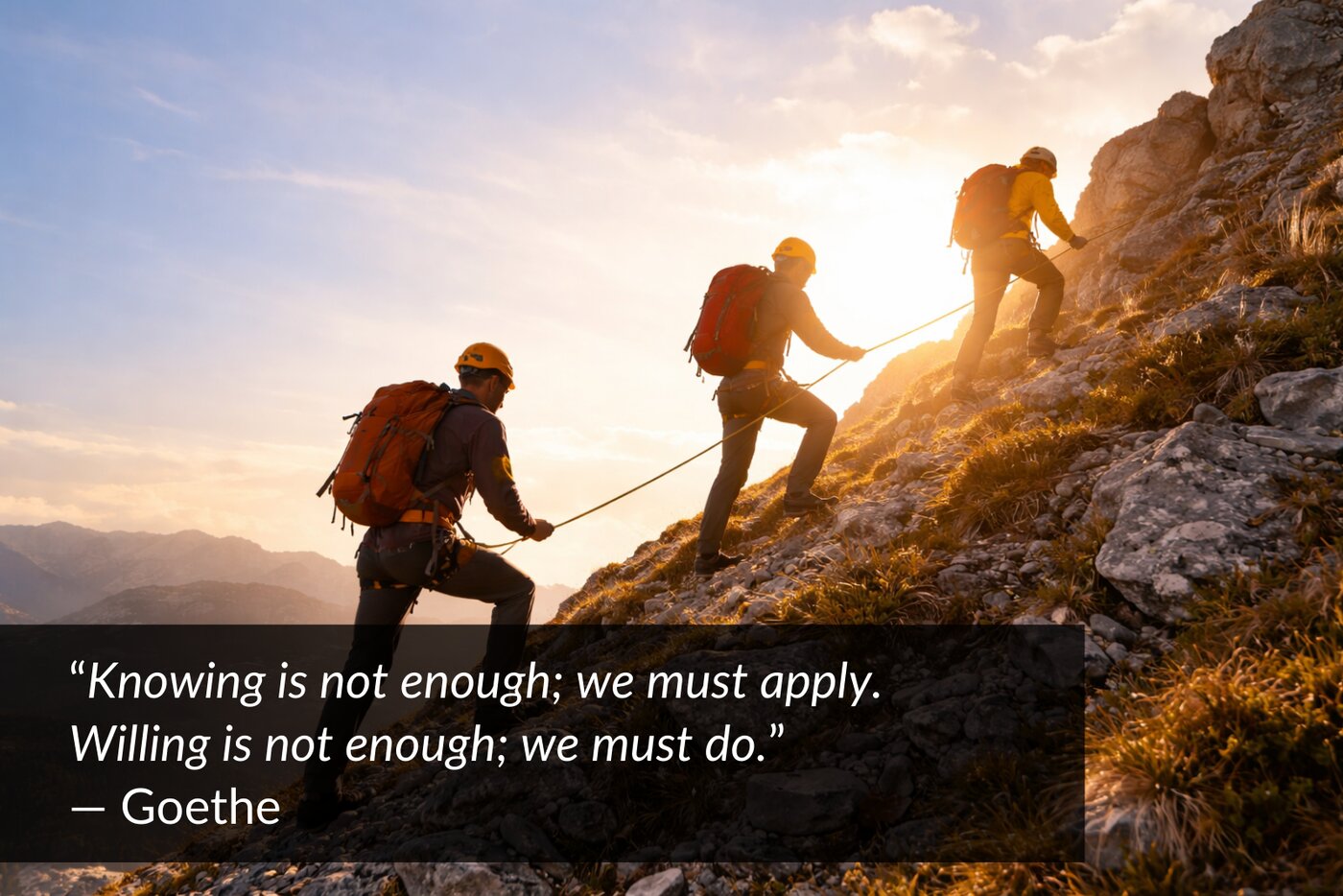
The compounding power of insight and action
Reading time: 3 min.
Most leaders are not short on ideas.
They read. They attend conferences. They exchange perspectives with smart peers. They leave conversations with clarity and conviction about what needs to change.
And yet, months later, very little actually has.
Not because the insight was wrong. Not because the leader lacked intelligence. But because insight alone does not compound.
Action does.
At the same time, action without perspective can amplify the wrong strategy just as quickly. Movement is not progress if direction is flawed. The real advantage lies in the disciplined combination of the two.
Perspective is leverage
High-quality insight is not just advice. It is borrowed pattern recognition.
When someone who has navigated similar terrain offers perspective, you gain access to compressed experience. You see risks earlier. You recognize tradeoffs more clearly. You avoid mistakes you would otherwise have learned the expensive way.
Research in psychology has long shown that we learn not only through direct experience but through modeled experience. We internalize patterns observed in others and integrate them into our own decisions. In practical terms, that means we do not have to pay full tuition for every lesson.
That is leverage.
But leverage produces no return unless applied.
Blind spots are structural
There is an uncomfortable but important reality in leadership: we are all less objective than we believe.
Decision research consistently shows that individuals tend to overestimate their clarity and competence in unfamiliar situations. This is not a character flaw. It is a structural limitation. We cannot easily see what we do not yet understand.
High performers assume blind spots exist. They do not wait for consequences to reveal them. They pressure-test their thinking. They expose their assumptions to challenge. They seek calibration before cost.
Insight, in this sense, is not a luxury. It is a discipline.
But discipline must extend beyond the conversation.
Clarity without movement
There is a particular kind of stagnation that affects capable leaders.
They know what to do. They have identified the difficult conversation that needs to happen, the strategic shift that should occur, or the standard that must be raised. The logic is clear.
Behavior does not change.
Behavioral research makes this unsurprising. The gap between intention and execution is well documented. Goals do not become outcomes simply because they are understood. They must be translated into specific behaviors and decisions. Without that translation, clarity remains theoretical.
Insight creates potential energy. Only action converts it.
Without movement, even strong perspective becomes intellectual decoration.
Why follow-through is hard
Acting on good insight often requires more than agreement. It may require abandoning a preferred strategy, reallocating resources, redefining roles, or admitting a prior misjudgment. Each of these introduces friction.
When new information challenges existing habits or identity, discomfort emerges. One way to resolve that discomfort is to change behavior. The easier way is to rationalize staying the same.
Growth rarely happens in comfort. Acceleration typically passes through it.
This is why so many sound strategies remain unimplemented. Not because they are unclear, but because they are inconvenient.
Movement creates refinement
Action has a second advantage beyond progress: it generates data.
When you move, you receive feedback. That feedback sharpens judgment. Whether you follow advice directly or choose a different path, movement clarifies assumptions and reveals constraints.
Inertia does none of this.
Over time, leaders who consistently pair perspective with action create a reinforcing loop. Better insight informs better decisions. Better decisions produce clearer feedback. Clearer feedback sharpens future insight.
That loop compounds.
Structure sustains the loop
Few people sustain this cycle by willpower alone.
Execution improves when there is structure. When commitments are made explicit. When progress is reviewed. When someone asks the uncomfortable follow-up question that prevents drift.
This structure can take many forms: trusted advisors, peer groups, boards, or coaching relationships. The format matters less than the function.
What matters is that insight does not evaporate and intention does not dissolve into routine.
The leaders who grow fastest are not necessarily the ones with the most ideas. They are the ones who consistently expose themselves to strong perspective and then move deliberately.
Deliberate action, deliberate restraint
It is also important to distinguish between thoughtful restraint and avoidance.
Action is not always motion. Strategic patience can be the highest-leverage move in certain contexts. But the difference between deliberate non-movement and fear-based paralysis lies in intentionality.
High performers choose either path consciously. They do not default into inertia.
The real multiplier
Insight alone is leverage. Action alone is effort.
When consistently paired, they become something more powerful. They reduce decision error. They accelerate execution. They build judgment grounded in evidence rather than instinct alone.
Most people have access to ideas. Fewer create environments where those ideas are challenged, refined, and activated. Fewer still sustain that cycle long enough for it to compound.
That is where the real edge lives.