Tackling the five dysfunctions of a team to boost business performance
Reading time: 4 min.
In today’s organizations, we often call any group of people a “team” simply because they work together and share a goal.
That definition is dangerously incomplete.
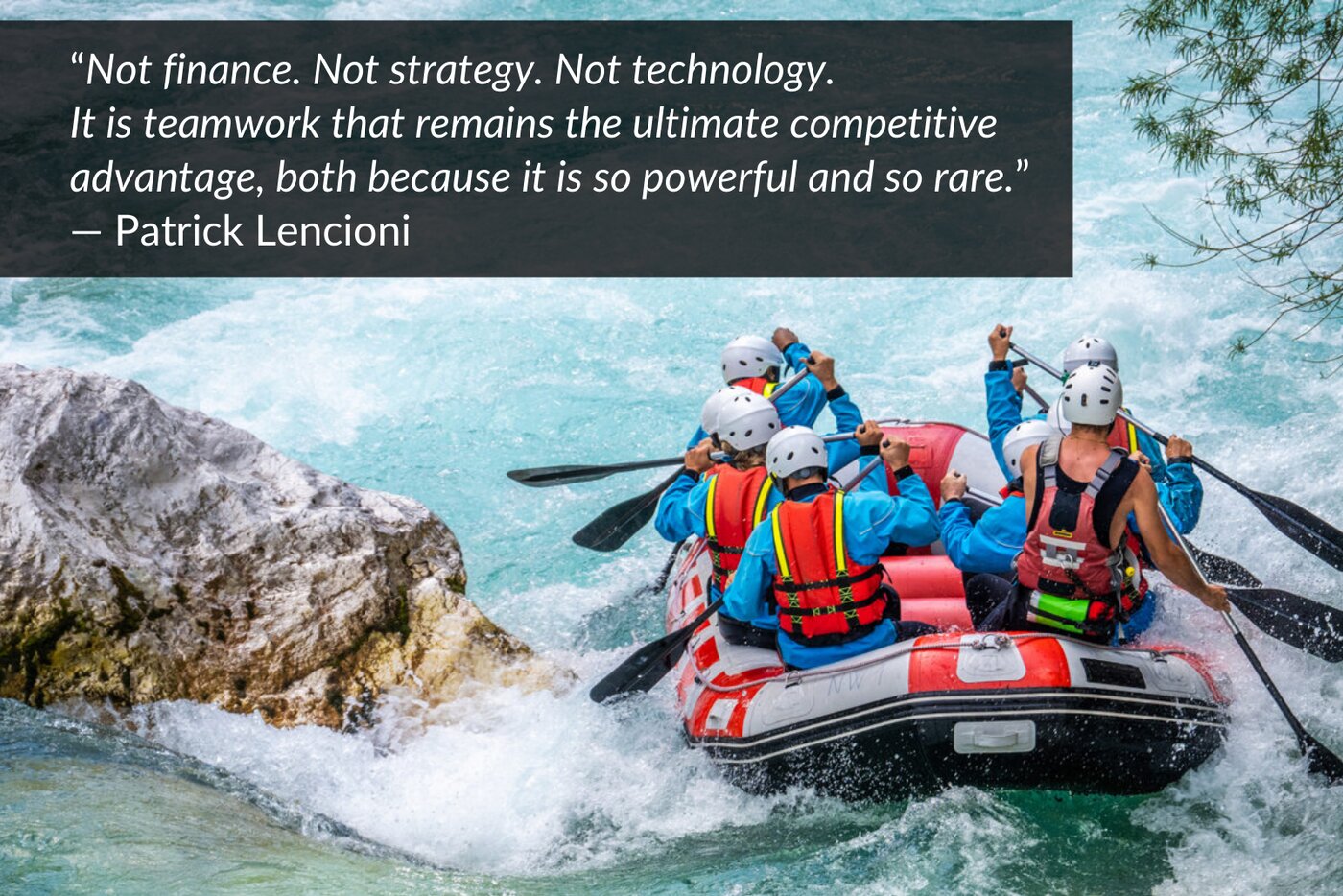
In sports or in the Army, a team is not defined by proximity or a shared objective. It is defined by team spirit. Mutual support. Trust under pressure. Willingness to sacrifice individual comfort or ego for collective success.
That difference matters.
In business, many so-called teams operate more like coordinated individuals than true teams. People show up. Tasks get done. Meetings happen. But when things get hard, performance drops, alignment fractures, and energy drains.
This gap is even more visible in senior leadership teams.
Ironically, the group with the most authority to steer the organization often struggles the most with alignment and trust. Strong individual performers. Smart people. Clear mandates. Yet limited willingness to challenge each other, surface tensions, or hold peers accountable.
That is not a people problem.
It is a team design problem.
Team spirit is not a feeling. It is a discipline.
High-performing teams do not emerge by accident. They are built deliberately, through shared norms, clear expectations, and reinforced behaviors.
This is where the work of Patrick Lencioni remains remarkably relevant.
Lencioni’s Five Dysfunctions of a Team offers a simple and practical way to diagnose the health of a team’s spirit and performance. Not through personality tests or abstract culture statements, but through observable behaviors.
His core insight is straightforward:
• Teams fail in predictable ways
• Team performance rests on a small number of foundational behaviors
• If those foundations are weak, everything above them becomes fragile
The five dysfunctions that undermine team performance
Lencioni presents the model as a pyramid. Each level depends on the one below it. When a lower level is weak, higher-level performance becomes unstable.
Below is a high-level overview of the five dysfunctions and their consequences.
1. Absence of trust
When trust is missing, team members hesitate to ask for help, admit mistakes, or acknowledge gaps in knowledge.
Consequences
• Defensive behaviors
• Low psychological safety
• Energy spent protecting image rather than solving problems
2. Fear of conflict
Without trust, teams avoid productive conflict. Disagreements go underground or get softened to the point of irrelevance.
Consequences
• Important issues remain unresolved
• Artificial harmony replaces honest dialogue
• Decisions lack rigor and buy-in
3. Lack of commitment
When ideas are not debated openly, people disengage from decisions they did not fully support or understand.
Consequences
• Ambiguous priorities
• Repeated discussions on the same topics
• Passive resistance after meetings
4. Avoidance of accountability
If commitment is weak, peers hesitate to hold each other accountable for behaviors and results.
Consequences
• Missed deadlines
• Uneven standards
• Growing frustration and resentment
5. Inattention to results
When individuals prioritize their own success, status, or department over the collective outcome, team performance erodes.
Consequences
• Poor overall results
• Siloed wins
• Higher turnover among strong contributors
The five benefits of a high-functioning team
What makes this model powerful is that it does not stop at diagnosing dysfunctions. Each level has a direct and positive counterpart.
When teams invest in strengthening these five foundations, the benefits compound.
1. Trust enables speed and learning
Teams with trust operate faster because they do not waste time managing perceptions.
Benefits
• Open conversations
• Faster recovery from mistakes
• Stronger collaboration under pressure
2. Healthy conflict improves decision quality
Productive conflict sharpens thinking and surfaces better solutions.
Benefits
• Better decisions
• More innovative problem-solving
• Reduced politics
3. Commitment creates clarity and momentum
When people feel heard, they commit more fully even if their idea is not chosen.
Benefits
• Clear direction
• Stronger alignment
• Higher engagement
4. Accountability raises standards
Peer-to-peer accountability reinforces expectations more effectively than hierarchy alone.
Benefits
• Consistent performance
• Reduced need for micromanagement
• Strong ownership culture
5. Focus on results drives collective success
When the team’s success becomes the primary scorecard, performance follows.
Benefits
• Sustained results
• Shared pride
• Strong retention of top performers
When leadership teams are misaligned, performance quietly bleeds
Misaligned teams do not fail loudly.
They fail quietly, expensively, and over time.
At the top of an organization, the cost of weak team dynamics compounds fast. Strategic decisions take longer. Execution drifts. Accountability softens. High performers compensate until they burn out or leave. Underperformance becomes normalized, not because leaders tolerate it consciously, but because the system allows it.
The result is not just frustration or disengagement.
It is lost productivity, avoidable mistakes, duplicated work, slow execution, and missed opportunities. Across organizations, these costs amount to millions of dollars every year.
This is why the Five Dysfunctions of a Team is not a diagnostic to run out of curiosity. It is a leadership mirror.
Leaders who take this assessment seriously often arrive at a difficult but necessary realization: not everyone on the team is contributing at the level required to move the organization forward. The most courageous leaders act on that insight. They clarify expectations. They coach where possible. And when needed, they make changes to ensure the team is strong enough for what lies ahead.
That is not harsh leadership.
That is responsible leadership.
You are entitled to build the strongest team you can. Your impact as a leader is inseparable from the quality of the team you lead.
At the same time, there is a hard truth many leaders avoid:
you eventually get the team you deserve.
If trust is weak, conflict avoided, accountability inconsistent, and results diluted, it is rarely a people problem alone. It is a signal that the work of building and maintaining team discipline has not been done consistently.
High-performing teams do not emerge through good intentions or proximity. They are forged through clarity, courage, and repeated attention to how people work together.
Team spirit is not optional.
It is a performance multiplier.
And for leadership teams in particular, neglecting it is one of the most expensive decisions an organization can make.