How to regain control when drowning in shifting priorities at work? Use this simple prioritization lens to resurface.
Reading time: 3 min.
You’re not imagining it, everything really is coming at you faster.
One minute you’re planning your day. The next, your inbox explodes, a team member needs input, your boss shifts priorities again, and your to-do list mutates beyond recognition.
You’re working hard. You’re always “on.” And yet, the feeling persists: I’m not getting to what matters most.
That sense of drowning? It’s not about time. It’s about clarity.
Why traditional to-do lists break down under pressure
Most productivity tools assume that time is linear and priorities are stable. But leadership is neither.
You don’t get clean blocks of time. You get interruptions. Escalations. Conflicting demands from your team, your boss, your clients.
So you try to keep up. You write longer to-do lists. You work longer hours. But the more you try to do everything, the less effective you feel.
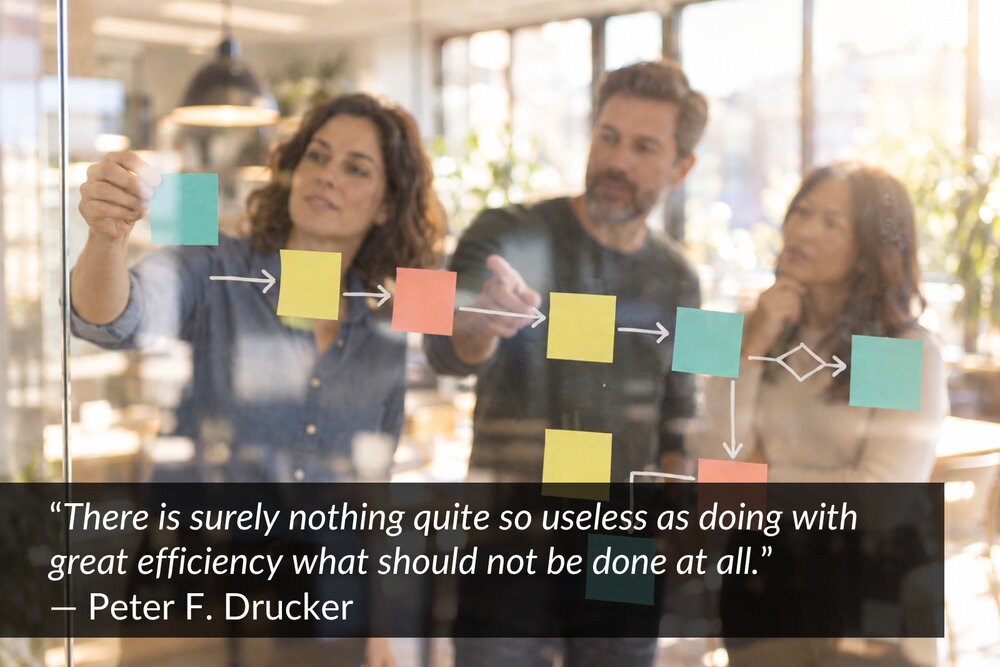
“There is nothing so useless as doing efficiently that which should not be done at all.”
— Peter Drucker
What you need isn’t more time or better apps. You need a better lens for making decisions—especially when time is tight.
A better mental model: tiered prioritization
High-performing leaders don’t treat all tasks as equal. Instead, they organize their time and responsibilities in tiers—based on strategic value, leverage, and downstream impact.
Think of it like decision triage. You focus first on what:
- Creates the most value
- Unlocks work for others
- Would cause real damage if delayed
Everything else? It gets deferred, delegated, or dropped.
This approach borrows from several well-established frameworks:
- Leverage thinking (Naval Ravikant): Do what multiplies your impact—decisions, systems, direction setting.
- Decision triage (used in medicine or the military): not everything carries the same weight. You have to prioritize based on critical impact and the consequences of inaction.
- Cognitive load theory (Sweller, Kahneman): Your brain needs shortcuts under pressure. Tiers reduce mental clutter.
- The Eisenhower Matrix (Stephen Covey): Prioritize importance over urgency—but tiering simplifies the logic when you’re under fire.
How the tier system works
Here’s a practical breakdown:
Tier 1 – Strategic and mission-critical
- Drives business outcomes
- Unblocks your team
- Can’t be done by anyone else
Tier 2 – Advisory and supportive
- Needs your input but not your full attention
- Can wait a day or two
- Builds toward Tier 1 work
Tier 3 – Operational or reactive
- Can be delegated
- Can be paused
- Doesn’t move the needle
The 1-hour test
If your day blows up—and let’s face it, it will—use this question:
“If I had just one hour to work today, what would move things forward the most?”
That’s your Tier 1 task. Start there.
Then ask:
“What can I do now that will help someone else keep moving while I’m unavailable?”
That’s leadership leverage.
Start small: try this for one week
- Sketch your week by energy zones
Block time for:- Supporting your boss
- Delivering key responsibilities
- Enabling your team
- Reorder your daily list by tiers
Don’t just write—rank. - Protect time for Tier 1
60–90 minutes. No email. No messenger app. Just focus. - End your day with one question
Did I spend time where it mattered most?
Final thought: clarity over control
You may never feel fully “caught up.” That’s not the goal.
The goal is to focus on the few things that truly drive impact—and let go of the illusion that everything deserves your attention.
“If you don’t prioritize your life, someone else will.”
— Greg McKeown, Essentialism
Your job as a leader isn’t to do it all. It’s to choose what matters—and make sure that gets done.