


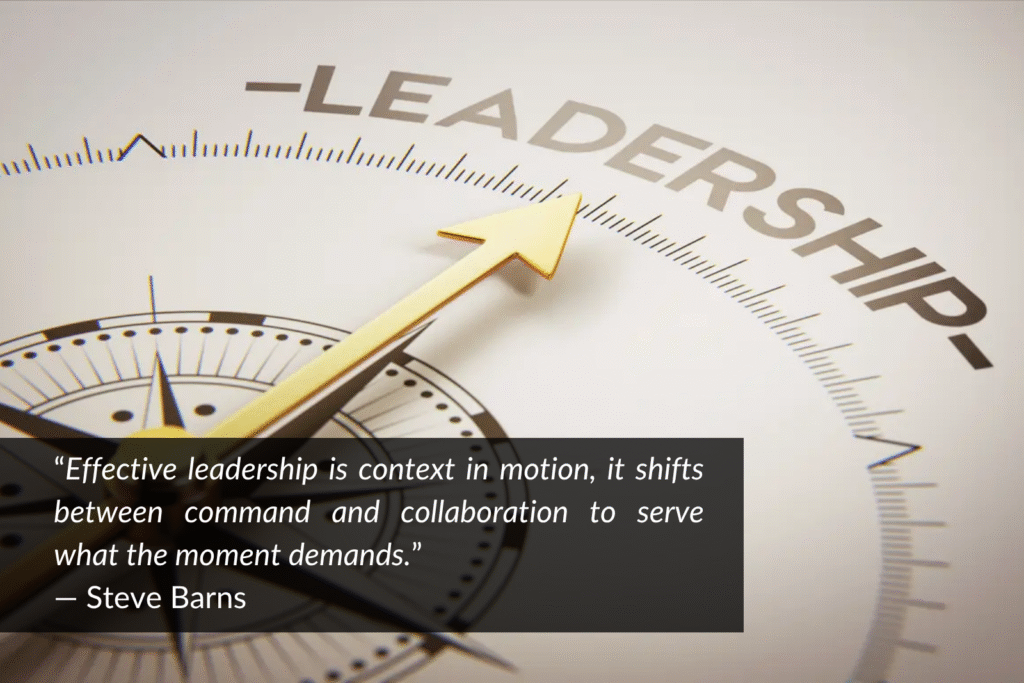
We often treat effective leadership as the gold standard. It is thoughtful, sustainable and built around people and purpose. But the truth is that even the most effective leadership can fail when it is applied at the wrong time.
Leadership isn’t one posture. It is a balance of stances, and knowing when to lean on each determines whether you survive a storm or build something that lasts.
Effective vs. conventional leadership
Effective leadership is purposeful and sustainable. It explains the why and the how, uses resources wisely and orients everything toward collective outcomes. It builds teams that are open minded, collaborative, creative, humble and service oriented. It listens, adjusts and creates conditions for others to thrive.
Conventional leadership tends to default to what is familiar or expedient. It focuses on what to do and dictates how, but rarely explains why. It can win in the short run, yet it often struggles to sustain performance. It is reactive, rarely consultative, rewards the loudest voice and treats feedback as optional.
Both approaches are stances, not fixed identities. The art of leadership lies in knowing when to use each.
Two stances, one responsibility
When the ship is taking on water, people need direction. Conventional leadership, decisive and structured, keeps the organization afloat. It stabilises, reduces ambiguity and creates temporary control so others can focus on doing the work.
But as the storm passes, that same stance becomes limiting. Overreliance on control turns speed into rigidity. What once created order can start stifling initiative and innovation.
That is when effective leadership becomes essential. The leader shifts from commanding to enabling, from short-term correction to long-term resilience.
During COVID, this distinction became strikingly clear. Many leaders discovered that decisiveness without transparency led to fatigue and confusion. Those who guided their teams with candour, empathy and vulnerability—openly acknowledging what they did not know and relying on their teams to navigate uncertainty—built stronger trust and adaptability. Their honesty did not weaken authority; it made it real.
What they share
Despite their differences, effective and conventional leaders have a few things in common:
- They set direction and define success
- They create momentum
- They deliver results
The difference lies in how those results are achieved and whether they compound over time or decay.
When the stance matters
- In crisis. Conventional leadership provides stability. Quick decisions, clear orders and controlled execution prevent escalation. Still, even in crisis, leaders who communicate openly and acknowledge uncertainty keep people engaged and aligned.
- In growth or renewal. Effective leadership fosters the creativity, trust and collaboration needed to take the next leap. It turns recovery into progress.
- In transition. The most successful leaders read the moment and adapt. Efficiency wins the day but effectiveness wins the decade.
Built to last, not just to win
In Built to Last, Jim Collins and Jerry Porras studied visionary companies that remained successful for decades. Their core finding: greatness comes from the ability to preserve the core while stimulating progress.
That principle maps directly to leadership. Conventional leadership preserves the core—it secures structure, order and focus. Effective leadership stimulates progress—it builds capacity, vision and innovation.
The best leaders balance both. They know when to tighten control and when to release it. They act with urgency without creating panic, and with humility without losing authority.
Why so many leaders remain stuck in conventional mode
- Selection by tenure, not aptitude. Many managers are promoted for individual output, not leadership capability.
- Low expectations for leadership quality. Few organisations define what “good leadership” actually means.
- No training or feedback loops. Without deliberate development, managers repeat what they have seen.
- Cultural inertia. When the loudest voice wins, reflection is seen as weakness.
The ROI of effective leadership vs the cost of conventional leadership
ROI of effective leadership
- Higher profitability. Business units in the top quartile of engagement achieved about 23% higher profit than those in the bottom quartile. (Source: Gallup)
- Sustained advantage. Organisations that improved their organisational health realised an 18% increase in EBITDA after one year and up to 35% higher total shareholder return during large transformations. (Source: McKinsey)
- Lower turnover and higher productivity. Companies with high engagement experience significantly less turnover and higher productivity. (Source: Chronus)
Cost of conventional leadership
- Massive productivity loss. Disengaged employees cost the global economy about 8.8 trillion USD annually. (Source: inFeedo)
- High turnover costs. Replacing a manager can cost up to 200% of their salary; disengagement drives higher turnover. (Source: The Happiness Index)
- Manager effect on engagement. About 70% of the variance in team engagement is attributable to the manager’s leadership quality. (Source: Gallup)
Becoming more effective at being effective
Improving leadership isn’t about changing your personality. It is about deliberate practice. The path is simple but demanding.
1. Reading
Expand your understanding through foundational works such as:
- Built to Last – Jim Collins & Jerry Porras
- Good to Great – Jim Collins
- The Practice of Adaptive Leadership – Ronald Heifetz, Alexander Grashow & Marty Linsky
- Multipliers – Liz Wiseman
2. Training
Leadership is a profession. Serious development requires more than inspirational workshops.
Executive education programs from leading business schools provide structured frameworks, real-life case studies and peer learning that reflect the complexity of modern leadership.
Programs such as Harvard’s Program for Leadership Development, INSEAD’s Advanced Management Programme and HEC’s Mini Executive MBA help leaders practice strategic decision-making under pressure and learn from peers across industries.
The key is to choose a program that combines theory with live application—business simulations, projects and feedback that translate learning into daily practice.
3. Coaching
Coaching is where leadership theory meets reality. It provides a confidential space to test, adjust and strengthen your stance while situations are still unfolding.
A skilled coach helps you reflect on which leadership posture best fits your business context, stakeholder expectations and political environment. They challenge you to grow through discomfort, to practice influence without authority and to recover faster from setbacks.
In short, coaching turns awareness into action and resilience.
4. Practice
Every meeting, decision and feedback moment is an opportunity to apply and refine your stance. Effective leadership is not a trait, it is a muscle.
Closing thought
Conventional leadership wins short battles. Effective leadership wins the long game.
The best leaders master both stances, decisive when the waters are rough, deliberate when charting new courses. They know when to steer hard and when to trust the crew.
That balance is what makes teams not only perform but endure. It is what turns good organisations into ones that are truly built to last.